
In 2008 the National Academy of Engineering published the treatise Grand Challenges for Engineering. This document summarizes the main issues that need to be addressed in the near future to advance the current state of our civilization, and to guarantee a sustainable progress towards an improved quality of life. Among the 14 Grand Challenges outlined we find the need to Restore and Improve Urban Infrastructure. In particular for the United States this grand challenge points out the outcomes of the American Society of Civil Engineers 2013 report card which rated the U.S. infrastructure with an overall grade of D+, and highlighted the need to improve the sustainability and resiliency of civil infrastructures around the world. Other countries are not exempt of this issue, and infrastructures all over the world are aging and failing at an increasing rate. The difficulty of the problem is exacerbated by the fact that solutions need to take into account several constraints, such as: i) limited economic resources; ii) sustainability, environmental and energy-use considerations; iii) the need to respond to natural disasters in a timely fashion.
In recent years structural health monitoring (SHM) has emerged to attempt to solve the crumbling infrastructure problem, or to at least provide a tool to improve current risk mitigation and post-disaster decision making strategies. To this end, metrics for the assessment of the structural condition and resiliency are used as quantitative measures of the state of integrity and the capacity of an infrastructure (or community) to recover after potentially damaging events, such as earthquakes and hurricanes.
The main feature of SHM is the extraction of information contained in vibration response measurements obtained using an array of sensors deployed throughout a structure of interest. The premise of this strategy is that vibration measurements contain information about the state of integrity of structures, or in other words, that the measurements are sensitive to physical changes that take place during severe events. It is worth to point out that the purpose of SHM is not to completely replace traditional approaches; instead, SHM is a powerful additional tool to be used as part of a more comprehensive decision making process that includes traditional non-destructive methods, risk analyses, repair-maintenance costs assessments, past experience and engineering judgment.
Bayesian probabilistic methods for structural damage diagnosis and prognosis
A major task of structural health monitoring (SHM) is the development of methods for structural damage diagnosis and prognosis. Damage diagnosis is aimed at assessing the current state of integrity of a system, which entails detecting, localizing, and quantifying structural damage. Damage prognosis aims to predict the future system performance and its remaining useful life. The objective is to develop a tool to accurately assess and predict if or when a structural or mechanical system needs to be repaired or replaced.
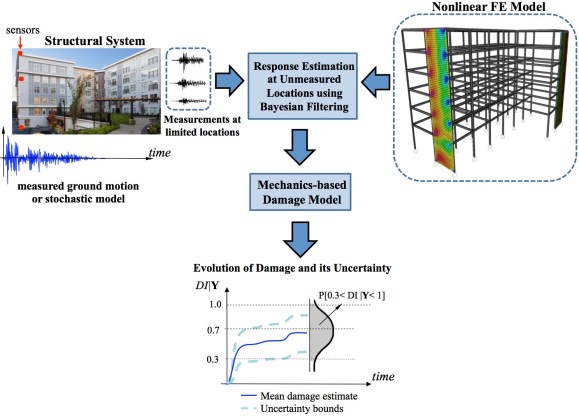
In this work Bayesian inference is applied to develop methods for structural damage diagnosis and prognosis with the accuracy and robustness to be successfully employed in practical applications where errors in modeling large-scale infrastructures play a predominant role. Of particular interest is the development of methods that combine mechanics-based damage measures with the response estimated using nonlinear (Bayesian) filters. The output of the approach is a quantitative measure of damage and its uncertainty in the form of an evolving damage index.
Some structures possess dynamic characteristics that make the diagnosis of damage using traditional vibration-based methods a difficult task. The problem is that in some applications the influence of damage in the measured vibration signatures is difficult to detect; examples of such structures include pipe systems and composites used in aircrafts wings and fuselage, where wave propagation interference and high-frequency effects make the detection of corrosion, cracks, or delamination (in composites) a difficult task. Acoustic emissions (AE) based approaches have shown to be effective in the localization of flaws in composites and plate structures. In this research statistical and probabilistic methods are developed and applied to localize AE sources corresponding to crack initiation and/or propagation regions.
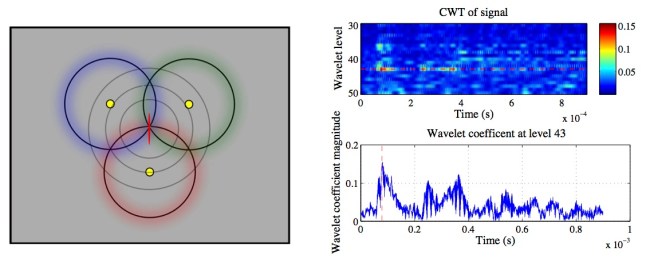
In this work Bayesian methods are applied to AE sources which are typically related to points where structural damage takes place. In particular triangulation-based methods are coupled with particle-based stochastic filters to estimate the source location posterior probability density function in plate-type structures. Structures of this type where AE sources may indicate crack initiation or the onset of damage include airplane wings and structural steel beams.

Related Publications
Sen, Erazo & Nagarajaiah (2017). Bayesian estimation of acoustic emissions source in plate structures using particle-based stochastic filtering. Structural Control and Health Monitoring. DOI.10.1002/stc.2005.
Erazo & Hernandez (2016). Bayesian Model–Data Fusion for Mechanistic Post-earthquake Damage Assessment of Building Structures. Journal of Engineering Mechanics, 142(9).
Hernandez & Erazo (2013). Nonlinear Model-Data Fusion for Post-Earthquake Assessment of Structures. Proceedings of the 9th International Workshop on Structural Heath Monitoring.
Decoupling structural damage and environmental effects
A major challenge in the application of structural health monitoring (SHM) is that the damage-sensitive measures typically employed (vibration frequencies, effective stiffness, effective damping, wave propagation velocity, among others) are sensitive not only to physical changes induced by structural damage, but also to physical changes induced by natural fluctuations in the environment (mainly temperature and humidity). In general the environmental effects are at least of the same order (and sometimes greater) of structural damage effects, and thus can completely mask the latter.
Fluctuations in the environmental conditions thus pose an obstacle for damage detection techniques since their reliability becomes questionable due to the increase in the probability of false-positive or false-negative damage estimates. Under these conditions the objective of an SHM method is to decouple structural damage from variations in the environmental effects. In other words, if a damage-sensitive feature at a given time shows departure from a reference healthy state, how can we assess if the change is caused by normal variations in the environment or structural damage. In this research statistical methods are employed to solve this problem.
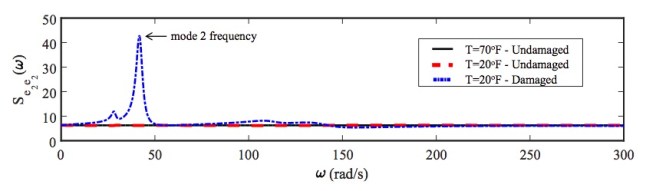
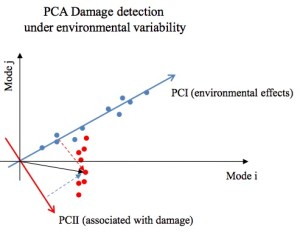
The methods developed are experimentally validated in real structures, such as the Z24 bridge in Switzerland. The Z24 bridge is well-known in the SHM literature since the monitoring program installed has served to study the efficacy and robustness of many methods in recent years.


Estimation of metrics to assess the resiliency of civil infrastructure systems
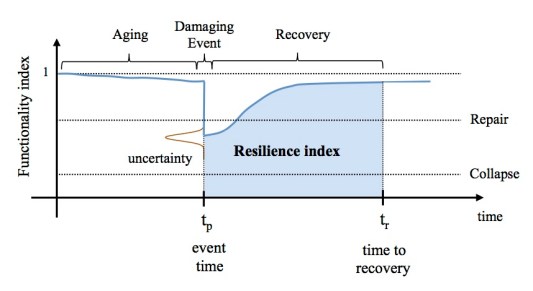
Resiliency is the ability of a community or a particular civil infrastructure to recover from the impact of extreme events. Resiliency metrics aim to quantify the ability of civil infrastructures to withstand and recover from natural or man-made disasters. In this research probabilistic estimates of different resiliency metrics are obtained for various natural hazards (mainly earthquakes and hurricanes). The objective is to provide quantitative tools that can support engineers and officials in post-disaster decision-making strategies.
 Structural Monitoring for Resilient and Sustainable Infrastructure