
Uncertainty is ubiquitous in the analysis and design of engineering systems. Sources of uncertainty in structural and mechanical systems include modeling errors (model class and/or parametric), measurement noise, unmeasured input excitations, and unknown initial conditions, among others. Probability theory provides a consistent, robust and rigorous theory that can be employed to model most of the sources of uncertainty observed in engineering systems. The quantified uncertainties can then be propagated to quantities of interest that are used for probabilistic condition assessment, robust performance prediction, risk analyses, and decision-making strategies under uncertainty. Research in this field has gained attention in recent years in part because of the increase in the computational resources available, especially parallel computing.
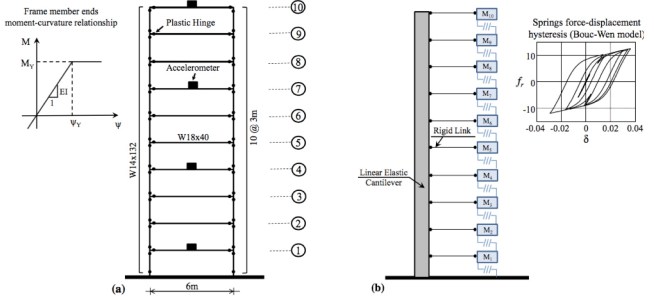
This research is focused in the development of uncertainty quantification and propagation tools for large-scale structural systems. In particular we are interested in the characterization of modeling-type uncertainties and their effect in structural damage measures. The goal is to develop probabilistic methods that yield robust models with the capability of accurately predicting the nonlinear response of structural systems, and their application to reliability-based analysis and condition assessment.
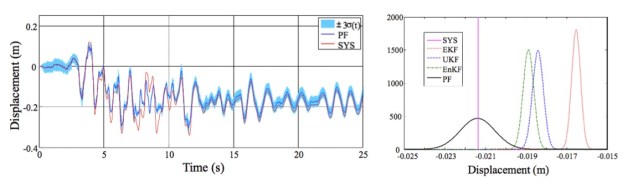
Left: Top displacement time-history estimate. Right: Maximum displacement estimate
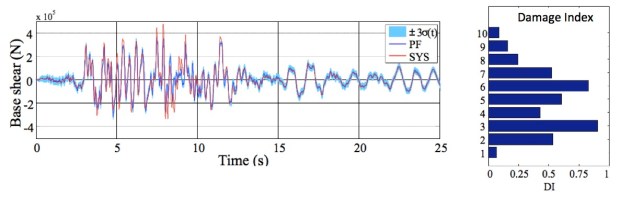
Left: Base shear estimate. Right: Damage index estimate
Publications
Erazo & Hernandez (2015). Uncertainty quantification of state estimation in nonlinear structural systems with application to seismic response in buildings. ASCE-ASME Journal of Risk and Uncertainty in Engineering Systems, Part A: Civil Engineering, 2(3).
 Structural Monitoring for Resilient and Sustainable Infrastructure